

What I did:
Research
UX/UI
Prototyping with Cursor AI
Overview:
Is the goal of every app simply to be as addictive as possible? The more time users spend on the app, the better? Are users simply statistics? Or are they real people who are impacted by decisions designed to keep them stuck?
A thought experiment in design, considering the philosophy and ethics of profit vs. taking users into consideration; based on qualitative (interviews, surveys) data rather than simply numbers of “time spent on the app”.
This project was born out of a question about users vs actual people using an app. To return to the best parts about Instagram, giving the user greater freedom to choose how they interact with the app, and not encouraging endless and mindless scrolling, wasting their time and eroding their trust.
On average, users spend 2 hours, 24 minutes on Social Media each day
Balancing Wellbeing with Revenue
THE PROBLEM
Recently, Instagram has been introducing more and more dark patterns, encouraging users to spend more and more time on the app to their own detriment.
The difficulty lies in that Instagram’s profitability relies on users being on their product long enough to advertise to them regularly, but also creates a bad reputation for the company, as users become more and more aware of the detrimental effects of the prolonged usage of social media.
Creating trust with users, supporting connection and community, whilst also protecting their well-being and being a profitable company through advertising revenue.
THE GOAL
How much time do people spend on social media?
How does it impact their mental health?
What’s Good?
RESEARCH
57%
of young people believe their mental health is getting worse.
42%
Cite social media as the main reason for the decline.
Social Media use decreases time spent on more healthful activities
Attention Fragmentation: Fast-switching clips train the brain to jump quickly, making sustained focus harder.
Digital Fatigue: Constant novelty can overload the brain, leading to a drained, foggy feeling after scrolling.
Lower Patience for Long Content: Instant gratification makes longer tasks feel boring or frustrating.
Anxiety and Restlessness: Heavy use is linked to higher stress, trouble unwinding, and disrupted sleep.
Dark Patterns
Deliberately tricking the user into spending more time on the app.
Instagram uses clever psychology, similar to the thrill of gambling, only this time it’s on a readily accessible and easy to reach smartphone.
https://dl.acm.org/doi/10.1145/3706599.3719771
Infinite scrolling makes it simple for users to lose track of time and engage in prolonged platform sessions by doing away with natural stopping points like page breaks
https://pmc.ncbi.nlm.nih.gov/articles/PMC11594359/
Customers are more likely to buy products from a company they trust and citizens are more likely to support business operations within their community if they trust the company.
Build user trust.
Balance the profit.
For users, there are many good things about social media, the ability to connect with friends and creators, showcase projects, get inspiration and learn new things, find products that suit and help them.
These mockups were created using Cursor AI
Keep the connection.
End the scroll.
REDESIGN
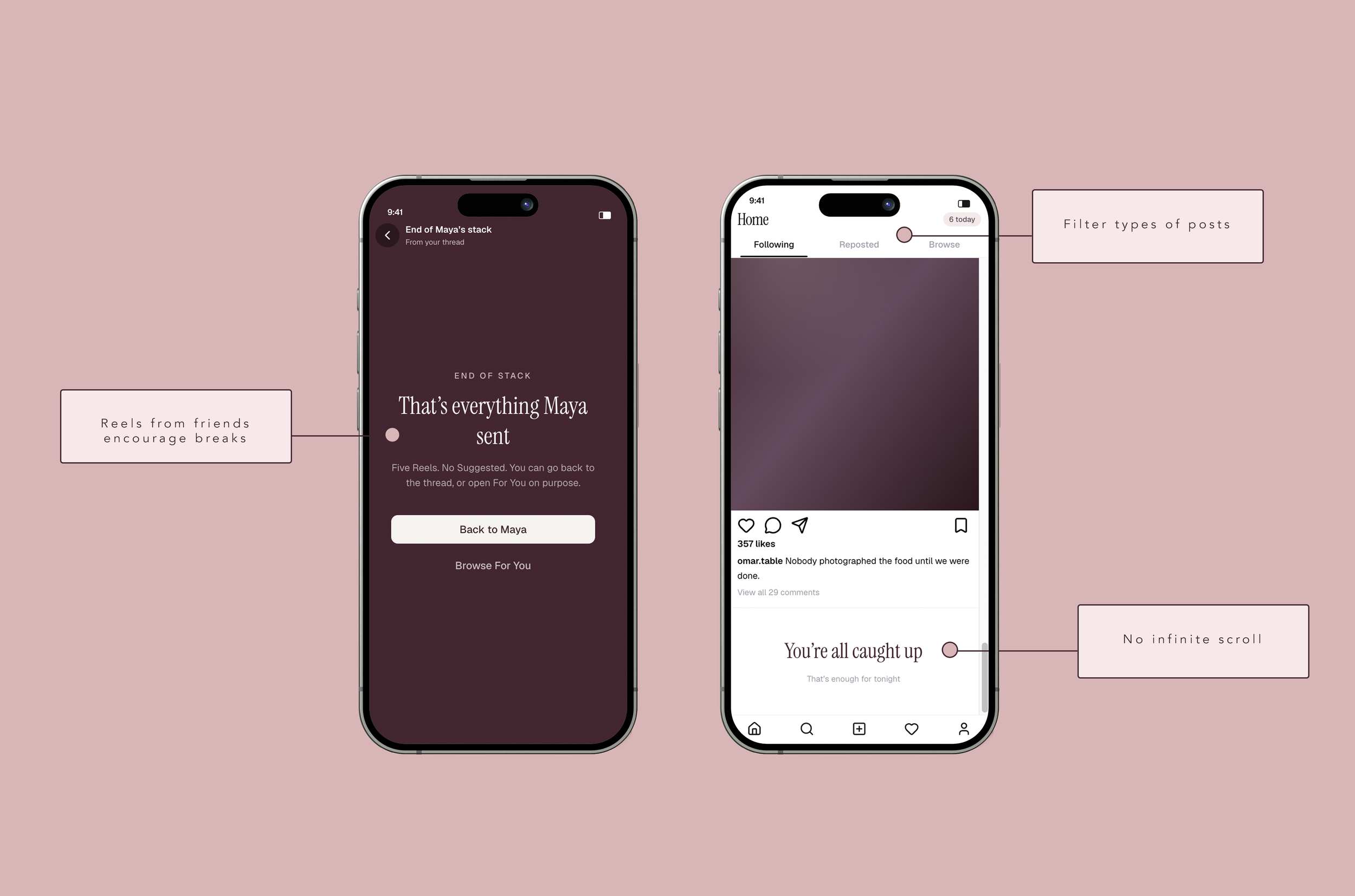
The default is no longer infinite, it has an end. Home splits into tabs that allow users more control over what they see: Following, Reposted and Browse, rather than one infinite feed tab that goes on and on until users snap out of it.
Ads would be dispersed throughout the feed, but also have an end.
See what friends sent without the trap.
REDESIGN
When a friend sends you a stack of Reels, Instagram opens the first one, then the next swipe is a trap back into the Suggested algorithm. This mockup treats the send as a playlist: scroll stays inside what they actually sent.
Every 5 or so reels there would be a reel or paid ad.
The last frame is an ending, not a path into infinite scrolling.
Prototype - Tabs and no infinite scroll.
Prototype - View reels from friends
Reflection & Learnings
Apps for Good
Researching this topic has made it abundantly clear to me that social media’s dark patterns erode user trust over time, negatively affecting people’s lives.
In order to have a great relationship with users and customers, technology needs to balance profitability with taking care of their users, and giving them a good experience.
Ethics
The difficulty lies in balancing profits with also making the world a better place, caring for others rather than just seeing users as a statistic and a number that needs to go “up”.
As more and more research shows up about dark patterns, their effects on mental health, it’s time to see the numbers as actual humans, and seeing the effect these decisions have on real people.
Testing
The exact ratio of posts from friends to advertisements would need to be tested to find the optimum amount without overwhelming the user.
Success Metrics
Revenue generated through ads, though no longer “infinite”
Surveys of enjoyment using the app (rather than amount of time spent)

Questions? Ideas? Let’s talk.
I'd love to hear your thoughts or chat about working together.
Also check out…
Inspected App Design
App design
SOLE UX DESIGNER
Cyrius MediaWorks Site Refresh
Web design
UI DESIGNER